Tuesday, June 15, 2010

Illustrator Tutorial – Create a Gang of Vector Ninjas

It can be quite tricky getting the hang of Adobe Illustrator, but if you take a step back and concentrate on the basics there's a range of options for creating great looking images. In this tutorial, we'll take a look at constructing a group of cool vector ninja characters using just the basic shapes and a variety of simple tools, making it a good start for Illustrator beginners.

Vector Ninja Characters
After opening up Adobe Illustrator, create a new document. For a fun project the size of the document doesn't matter, Illustrator has a vast area of artboard beyond the document edges that can be used. I personally use the CMYK color mode out of habit and the ease of managing blacks, but a wider range of colours are available with RGB. The choice should really depend on the final outcome of the project; print or web.

Depending whether your Illustrator software has the default settings, you might want to check the options for the scaling of strokes and effects, this little option could save you a headache layer down the line.

Grab the Circle Tool and draw a shape on the artboard, hold the SHIFT key to create a perfectly equal object. By default this will have a white fill and black stroke.

Select the Square Tool and draw another shape on the artboard, position this to overlap the original circle. Use the Align Palette to centre the two shapes horizontally.

From the same menu, use the Rounded Rectange Tool to draw a small leg. Adjust the roundness of the corners with the keyboard cursor keys until the ends are completely circular.
Zoom in and position the leg exactly in relation to the edge of the square body.

Duplicate the leg and move into position for the remaining limbs, for the arms rotate the shape by 45 degrees. To position the shapes behind the other objects, press the CTRL + [ and CTRL + ] keys repeatedly to adjust the stacking order of the selected objects.

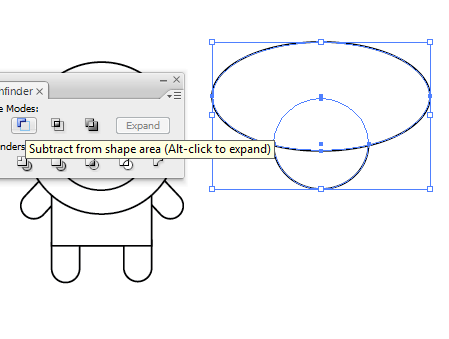
Draw another perfect circle onto the artboard, and beside it a much larger oval. Overlap the two and use the Align Palette to position exactly.

With the two shapes selected, click the Subtract from Shape Area option from the Pathfinder palette. Click the Expand button to refresh the bounding box of the shape.
By using temporary shapes as tools along with the Pathfinder options, a range of custom objects can be created.

Position this semi-circular shape within the large circle of the character to represent the facial area. Draw in a small circle as an eye, fill this with a black swatch and clear any stroke. Copy and paste in front (CTRL + F), then move horizontally to the side (hold SHIFT to constrain the axis)
Grouping any pairs of objects, such as the eyes and arms will allow them to be centralised with the other objects using the Align Palette without being moved individually.

With the complete line-work character laid out and aligned, draw a selection around the complete object and copy and paste a duplicate. Move a copy off to the side as a backup.

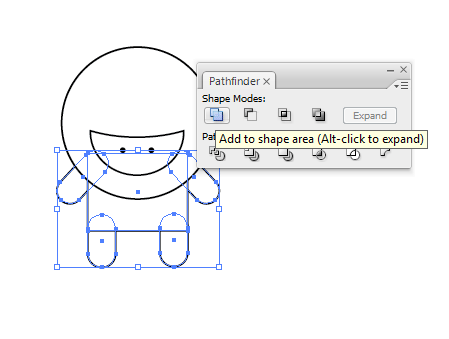
With all the objects that make up the torso and limbs selected, chose the Add to Shape Area option from the Pathfinder tool and Expand to merge the shapes into one.

Fill the body elements with a very dark grey (95% black) and add a 4pt stroke aligned to the outside at 100% black.

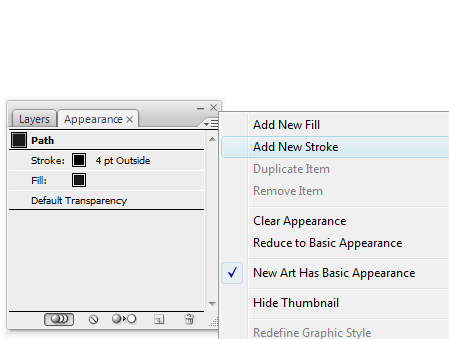
In the Appearance Palette, click the small options arrow and select Add New Stroke.

This time, add a 4pt stroke aligned to the inside, with a lighter, 93% black. This multiple use of strokes is a technique I've come to use in my character designs which really helps lift the colours by adding a little depth and variation.

Select the facial area and fill with a pale skin tone, add a slightly thinner stroke at 3pt aligned to the outside using the 93% black.

Add a New Stroke through the Appearance Palette and give this line a slightly darker tone, aligned to the inside of the shape.

The basic version of the character is complete, ready for some stealthy ninja action.

Copy and paste multiple variations of the original line-work character. Adjust and rotate the limbs into a range of scary ninja combat positions, adjust the stacking order of the arms to in front or behind the body to give different effects.

With each individual character, repeat the process of merging shapes and colouring the objects to produce a group of cool ninjas. However, no ninja would be complete without combat accessories…

Create a staff using a long thin rectangle, fill the object with brown while adding a black outline.

Create a pointed object using the Star Tool, using the Direct Selection Tool select each of the points of the path from each arm of the star.

Upon selecting the Rotate Tool, the point of origin will automatically default to the centre of the object. Click and drag to adjust the overall shape of the star.

Draw a solid circle in the centre and fill the death star weapon with a metal like grey. Add a black outline and a secondary inner stroke with a slightly darker grey.

Using the same colour scheme, draw a triangle by dragging a shape with the Star Tool and pressing the downwards cursor key to reduce the number of points. Grab the upper most point with the Direct Selection Tool and drag vertically.

Select and drag the middle two points to squash the lower half into a sword like shape. Finalise this with a small brown rectangle, remember the majority of the handle would be concealed by the hand so only a small section is required.

Use the Pen Tool to neatly draw in a three sided shape to represent the chamfered finish of the sword blade.

Create two Nunchuk handles and the beginning and end points of the adjoining chain. With both chain elements selected head to Object > Blend > Make

Go back to Object > Blend > Blend Options, enter 5 under the Specified Steps option to alter the type of blend to give a line of individual items.

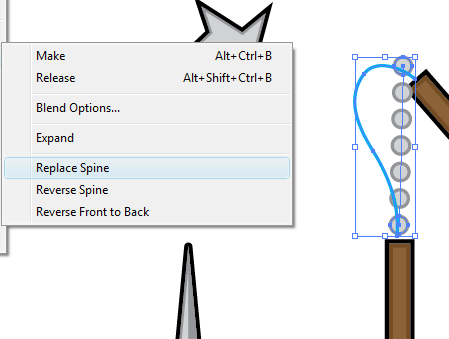
Use the Pen or Pencil tool to draw a temporary line to symbolise the desired route of the Nunchuk chain, with this and the blend selected, go to Object > Blend > Replace Spine.

Group each individual weapon and move into place on the various characters, completing the group making them ready for action!
Vector Ninja Characters
Using basic vector shapes, a stylish and fun image can be created using just the basic functions of Adobe Illustrator.

Adobe Illustrator CS5 – What’s New?

 
Anyone who works in Adobe Illustrator will find a number of attractive features in its new version. The new features include variable width strokes, Bristle Brush, Perspective Grid, anti-aliasing text for the Web, Flash Catalyst integration. These and more new tools and features make Adobe Illustrator CS5 a compelling upgrade for creative professionals using Illustrator.
First let’s see what new is there for painting.
- A new Width tool provides possibility to vary the width of strokes. When a path has been created and a stroke color chosen you can select the Width tool and increase or decrease thickness of the stroke by dragging a small diamond which will appear on the stroke. The width will change only in that part of stroke where you apply the tool and it will taper down (or up) toward the ends of the path or the next corner anchor points, which will retain the path’s original thickness. In similar way you can change as many parts of a single stroke as you wish. And also there is a possibility to save a pattern of alterations and apply it to other strokes. Unfortunately this tool can not be used to alter brush strokes.
- Now there is more control over art and pattern brushes. Previously they were equally distributed along their paths, but in Adobe Illustrator CS5 you can choose which parts of a brush will stretch and which will remain unchanged. For example, decorative ends of a banner brush can now be protected to retain a permanent size while the middle section of the brush is extended as far as necessary.
- A new tool Bristle Brush allows more natural painting in vector than ever. It provides a great variety of options for brush shape (round or flat) and style (point, blunt, curve, angle, or fan), bristle length, density, and thickness, paint opacity and stiffness.

In CS5 great improvements were made with regard to brush cornering. It is now easier to control intersection and joining of pattern segments avoiding awkward collisions or empty spaces. Dealing with dashed lines was improved in similar way. Dashed lines can be arranged easily and neatly in the places where path segments of different lengths meet or where a path angle changes. Also Precision scaling of arrowheads was added to Adobe Illustrator CS5.
Now let’s review what those who design for the Web or Flash Platform applications gain with upgrade to Adobe Illustrator CS5.
- Text anti-aliasing system newly adopted by Adobe Illustrator CS5 provides new possibilities for creation of Web graphics with text. Now you can optimize the rasterization of type destined for the Web or mobile devices by setting its anti-aliasing to be Sharp, Crisp, Strong, or not anti-aliased.
- Adobe Illustrator CS5 provides a number of new capabilities which make it compelling for developers working in Flash, Flash Builder, Flex, or Flash Catalyst. Files in Illustrator CS5 can be saved in the FXG format for further work in Flex. Also it is very efficient to use Adobe Illustrator CS5 with entirely new application Flash Catalyst. After a web page or its separate elements have been designed in Illustrator the file can be opened in Flash Catalyst and necessary elements can be made interactve. And then the interactive pages can be again opened in Illustrator for further creative work without loosing the results of work done in Flash Catalyst.
 Adobe Illustrator CS5 includes a new tool for creation of three-dimensional images. This tool is called Perspective Grid and it simulates drawing in three-dimensional space. It makes drawing in perspective fast and easy.

There are even more new or improved features in Adobe Illustrator CS5 which may seem not so exciting but are really going to make the creative process faster and easier. The new Shape Builder tool provides a more efficient way to control, combine, and divide pieces of overlapping elements.
Among other new Illustrator features and abilities are new modes to draw behind or inside objects, the ability to select objects behind the current object, better path joining, 9-slice scaling of symbols (a kind of intelligent scaling), and resolution-independent effects. Also From now on a default starting position of vertical and horizontal axes in Illustrator is in the top left as it is in other CS applications, and not in the bottom left as it used to be in previous versions of Illustrator.
Live services provided by Adobe are also integrated in Illustrator CS5. Adobe BrowserLab provides possibility to check how a Web page will look in different browsers. CS Review enables easier and faster team project management. Also there is a panel linking to helpful Illustrator how-tos and other resources. The live services are complimentary during a year after signing up.
Adobe Illustrator CS5 is amazingly faster than its ancestors. For example, when tested CS5 took only four seconds to render a very complex project while CS4 required 20 seconds to fulfill the same task on the same hardware. And naturally thanks to faster operation the workflow productivity is increased. This alone makes upgrade to CS5 worth the price. But undoubtedly every user will find a number of enchantments which will accelerate their work and make it more efficient.

Saturday, June 12, 2010

James Corden comes out on top after on-stage clash with Sir Patrick Stewart at the Glamour Awards

He might be a veteran of the stage and screen but Sir Patrick Stewart should have kept consulting his script before insulting James Corden last night.

Hundreds of guests at last night's Glamour Awards in London looked on in shock as the critically-acclaimed actor tried to make fun of the portly comedian's weight but then saw his jibes spectacularly backfire.

Celebrities such as Cheryl Cole, Lily Allen, Nicole Ritchie and Denise Van Outen, took in the embarrassing scene as the Star Trek star launched a verbal attack on Corden, who was hosting the glitzy event in Mayfair's Berkeley Square.
You calling me fat? James Corden urges Sir Patrick Stewart to continue insulting him after the Star Trek actor insulted him about his weight on-stage at the Glamour Awards last night

You calling me fat? James Corden urges Sir Patrick Stewart to continue insulting him after Star Trek actor made fun of his weight at last night's Glamour Awards

Sir Patrick was invited on stage to present the gong for Film Actress of the Year to Avatar's Zoe Saldana.

But instead he took the opportunity to criticise the way Corden was standing.

He told the comedy star not to stand at the back with his hands in his pocket because it made him look like he would rather be somewhere else when people came up to collect their awards.

Then he decided to have a dig at Corden's weight - a big mistake.
Don't do it, sir: James tries to stop the actor halfway through his rant as he asked him to hurry up and present an award to Avatar's Zoe Saldana

Bad knight: James tries to stop the actor halfway through his rant as he asked him to hurry up and present an award to Avatar's Zoe Saldana

He said: 'From where I was sitting, I could see your belly. And that was from right over there at the back of the room. These people down here....'

He then looked at Corden, who said: 'Sorry, I'm waiting for the punchline. Go on. You could see my belly but I can see you dying right now.

As the crowd laughed nervously, Sir Patrick asked them: 'One more, do you want one more?'

In reference to Corden joking earlier in the evening that he fancied Nick Jonas, Sir Patrick said: 'If you fancy the Jonas Brothers, cover your belly.'
Calm down: James tries to pacify Sir Patrick as Zoe Saldana comes to the comedian's rescue

Calm down: James tries to pacify Sir Patrick as Zoe Saldana comes to the comedian's rescue

As Corden stood smiling in bemusement behind him, Sir Patrick then gave Saldana the award.

And she was quick to jump to Corden's defence, as she said, to a round of applause and cheers: 'For whatever it's worth, I like your belly.'

And as Corden and Sir Patrick argued in the background, she added: 'But I would pay to see Sir Patrick Stewart dying on stage any day.'

After Sir Patrick had left the stage, Corden told the audience, 'I feel bad for people who haven't seen my belly', before he lifted he shirt and rubbed his stomach.
Big and proud: James gives the audience a flash of his belly after Sir Patrick leaves the stage

Flash of the flesh: James Corden gives the audience a glimpse of his belly after Sir Patrick leaves the stage

Then, to a burst of applause and laughter, he said to Sir Patrick: 'OK can we get a taxi really quickly please. There's an old man going home.'

Apart from Saldana, many other stars jumped to Corden's defence as the evening went on, including Nowhere Boy actor Aaron Johnson, who won Man of the Year, and remarked: 'I love your belly. That was intense. I didn't know where to look.'

Singer Duffy, who got on stage to present Yoko Ono with the Outstanding Contribution accolade, added: 'James is doing a wonderful job. Highly entertaining.'

Speaking about the incident after the event, Corden said: 'I sound like my mum. I wasn't angry. I found it quite disappointing. You should ask him about it but I'm certain he's left.'

School's out! Glee stars get flirty on summer break

School's out for the cast of Glee and they're already making the most.
Actress Jenna Ushkowitz, 22, and co-star Kevin McHale, 21, were spotted frolicking on the beach in Monaco, France, yesterday.
Jenna, who plays Tina Cohen-Chang on the hit show, paraded around the foreshore in a blue and white striped bikini while Kevin, who plays wheelchair-bound Artie Abrams, put his toned torso on show.

Jenna Ushkowitz and Kevin McHale
Making a splash: Glee stars Jenna Ushkowitz and Kevin McHale frolicked in the surf in Monaco yesterday
Jenna Ushkowitz
 Jenna Ushkowitz
Summer break: The pair soaked up the sunshine

The pair dated on the show and it seems they have chemistry off-screen too.
They were flirting up a storm as they splashed around in the surf before exchanging whispers on the sun lounge.

While stars are in France for the 50th annual Monte Carlo TV Festival, but they are clearly having no trouble mixing business with pleasure.

The Glee season finale aired in the US on Tuesday night, and will be broadcast in the UK on Monday.
Jenna Ushkowitz and Kevin McHale
Chemistry: Kevin and Jenna dated on the show and it seems their close off the set too
Nearly 11million American viewers watch the McKinley High gang compete for the Regionals title.
Kevin said it was an emotional end for the cast: 'More than any other episode I kind of think this touches to us more personally in our real lives than us just our characters, because it kind of is our whole journey from the past year and a half, being on the show.'
They are now gearing up to begin work on the highly anticipated second season.

Monday, June 7, 2010

Pastore knocking on Diego's door

http://www.fifa.com/mm/photo/worldfootball/nationalteams/01/15/19/06/1151906_large.jpgThe classic No10, a player blessed with sublime skill, extrasensory vision and impeccable passing ability, is in short supply. Yet one man who slips effortlessly into that hollow bracket is Javier Pastore, who is hoping to persuade Diego Maradona to take him to the 2010 FIFA World Cup South Africa™.
And though the attacking midfielder, who will turn 21 on 20 June, two days before Argentina’s final group match against Greece, did not feature in his country’s midweek win over Germany, he is still in with a fighting chance of making the Albiceleste plane. Indeed, a goal in a friendly against Catalonia in December 2009 on his senior international debut has put him firmly in the frame, as have a series of outstanding displays for Palermo, whom he has helped push for UEFA Champions League qualification.
Not that Pastore is getting carried away: “I just want to keep doing my best and prove to the Argentina coaching staff that I’m capable of playing for the national team,” he said. 
Hailing from the Argentinian city of Cordoba, Pastore’s first steps on the professional football ladder were taken at Talleres, one of the area’s leading teams. Brought into the club’s youth ranks at the age of nine, he had been recommended by his school's physical education teacher, who felt the rangy youngster’s basketball prowess could be transferred to the football pitch. “I even carried on playing basketball while I was coming up through the youth system. And I still follow the NBA,” said El Huesito.
“I just went for it. I’d never played on a full-size pitch before and the day I went on trial at Talleres my dad said I ought to tell them I was a No10. And that’s where I stayed,” he explained, on how a player measuring in at over six foot made a niche for himself in a role normally reserved for more diminutive performers. “I like how (Juan Roman) Riquelme and Kaka play, they’re two great players. I think that my game shares some similarities with theirs, but I can’t compare myself to them – I’m only just starting out.”
That may be the case, but Pastore has made giant strides since his first-team debut for Talleres as a 17-year-old in the side’s promotion campaign under coach Ricardo Gareca. After just five appearances, however, he was on his way to join Huracan in 2007, where administrative problems and a serious ankle injury meant 2008 was a virtual write-off on the playing front.
Thus it was in the first half of 2009 that his stock really began to rise, after playing a starring role and contributing seven goals to Huracan’s eye-catching Clausura campaign, when Angel Cappa’s expansive side were pipped to the title on the final day of the season by Velez Sarsfield.
Cappa, whose CV includes spells in Spanish football working as an assistant coach to Jorge Valdano, had this to say about his former charge: “Javier is an exquisite player, and there are not many of those about. As soon as I saw him, I knew he had a brilliant career ahead of him.”
The feeling was mutual, with Pastore revealing just how Cappa’s tailored methods helped him explode on to the Argentinian scene. “Angel treated me differently to the others. He’d send them all off running while he took me to one side to talk and explain things about the game. My team-mates used to give me grief for being the coach’s favourite. I think, deep down, they were right.” 
Following reported interest from European giants such as AC Milan and Chelsea, Pastore eventually made a multi-million-pound move to up-and-coming Palermo. And he has flourished on Italian soil, appearing in 23 of his new team’s 26 Serie A encounters so far, though his first goal did not come until a 4-2 defeat by Bari in late-January. It was his performance in last week’s 2-0 win at Juventus that really made people stand up and take notice, with respected daily Corriere dello Sport stating that “it was his presence, undisputed class and strategic vision that guided Palermo to victory”.
Palermo coach Delio Rossi said: “God has given him huge talent and a lot of intelligence, but he’s still young. If he listens to me he’ll be able to carve out real openings for himself." The man of the moment is taking it all in his stride, though. “The only thing that’s changed is that in Italian football I’m required to do more for the team when we don’t have the ball.”
So, will said additions to his all-round game help Pastore live up to the great expectations of Cappa and Rossi? Is there time enough to cement a place in Maradona’s plans for South Africa 2010? As is so often the case in football, only time will tell.


Sunday, June 6, 2010

Johnny Depp, Robert Pattinson -- Who Will Be 2010 MTV Movie Awards' Global Superstar?

Johnny Depp Stardom comes in many different shapes and sizes, and the 2010 MTV Movie Awards pay tribute to all of them. There's Breakthrough success, the acclaim that comes from a star-making turn or performance in a film. There's Badass success — which certainly should speak for itself. And then there's the Global Superstar, that actor or performer whose success has transcended geographic borders, age groups and gender to become recognized all over the globe -- not only for their roles, but for themselves. Here's a look at this year's contenders:
Johnny Depp
From Edward Scissorhands to Ed Wood, from Jack Sparrow to the Mad Hatter -- after so many unforgettable characters, it's hard to imagine anyone doesn't know who Johnny Depp is. Although he's spent the majority of his career realizing oddball roles in movies of all sizes, he seems to have finally found a series of films that suit his larger-than-life characterizations, including (most recently) the particularly-mad Mad Hatter in longtime collaborator Tim Burton's highly-anticipated film version of "Alice in Wonderland." With "Dark Shadows," "The Lone Ranger" and of course another "Pirates" movie on the horizon, Depp's superstardom is in no danger of waning, and among the nominees, his is perhaps the longest-running. 
Taylor Lautner
Prior to 2008, Taylor Lautner was probably best known as the Sharkboy in Robert Rodriguez's family-friendly adventure "The Adventures of Sharkboy and Lavagirl." But '08's "Twilight" brought him an entirely new kind of recognition — a recognition that he knew well enough to protect when time came to reprise the role in "New Moon." Bulking up to proper hunk size, including a formidable set of abs, Lautner made himself more than a match for the looks and charm of Robert Pattinson's competitor for Bella's attention, Edward Cullen, and exploded across the globe as a star in his own right. Although he's just starting to capitalize on that success by appearing in other blockbusters like "Valentine's Day," Lautner is the kind of movie star whose visibility more than makes up for his longevity.
Robert Pattinson
Even if he hadn't stepped into the shoes of Edward Cullen, the dreamy, translucent crush object for millions of teenage girls (and their moms) from the "Twilight" book and film series, Robert Pattinson would still be a star thanks to his turn as Cedric Diggory in two of the "Harry Potter" films. But about a second after he offered his first in a series of longing stares at Kristen Stewart's Bella in the first "Twilight" film, he became an international icon, and hasn't slowed down since that film was released in 2008. Additionally, he immersed himself in several non-"Twilight" roles in films like those in "Little Ashes" and "Remember Me," proving not only that he can open a movie on the strength of his fandom, but take a bite out of a variety of characters, whether or not they're vampires.
Daniel Radcliffe
Radcliffe was only 12 when the first Harry Potter film was released in 2001 — and if you look back at him then, he was a tiny, adorable charmer in oversized glasses and a Hogwarts gown that practically swallowed him whole. But a decade later, Radcliffe has matured into not only the grown-up hero that Harry himself has become, but an adult star in his own right, offering remarkable performances on stage and screen that attract audiences of all shapes and sizes. As the first part of "The Deathly Hallows," an epic adaptation of the final book in Harry's saga, arrives in theaters in November of 2010 — you'll see an exclusive clip during the Movie Awards tonight — Radcliffe is poised to become one of the world's most recognizable performers.
Kristen Stewart
After a couple of uncredited and low-key roles in films like "The Flintstones in Viva Rock Vegas," Kristen Stewart broke into the public consciousness as the daughter of Jodie Foster in David Fincher's terrific 2002 containment thriller "Panic Room." Flash to six years later, she creates her own panic rooms wherever she goes thanks to her unforgettable turn as Bella, the iconic wallflower-turned-vampire lover in Stephenie Meyer's Twilight book series. In the meantime, however, she's done an amazing job showing that she's more than the devoted girlfriend of a handsome bloodsucker, playing in acclaimed films like "The Runaways," "Into the Wild" and "Adventureland" as she proves that her recognition and success is well-deserved.
Don't miss the live red-carpet coverage, exclusive movie clips and fist-pumping action on MTV News' "Jersey Shore Blow-Out at the MTV Movie Awards," airing live from Los Angeles tonight at 8 p.m. ET/PT. Then stay tuned for the 2010 MTV Movie Awards at 9 p.m. ET/PT.

MTV Movie Awards 2010 Winners List

MTV Movie Awards 2010 Winners List — The MTV Movie Awards 2010 will be aired on Sunday 6, June 2010. If last year it was held in New York City, the location for this year is turning to Los Angeles.
As one of the biggest annual award shows owned by MTV, 2010 Movie Awards must be awaited by million people all over the world.
Check out the full MTV Movie Awards 2010 winners list below.
However, there’s no official list yet at this moment. It will be updated once the whole announcement completed.

Saturday, June 5, 2010

Download Glee season finale 2010 to enjoy an incomparable combo of music and drama

Download Glee season finale 2010 to enjoy an incomparable combo of music and drama Glee Season finale is ready to rock. As everyone knows that Fox's Golden Globe Award-winning musical-comedy-drama series first season is going to end on Tuesday. An old saying describes the effect of music as mood-uplifting, stress-relieving and confidence-enhancing. Glee’s music embraces similar power.

From time to time fans of this musical show have feasted their eyes on exhilarating episodes devoted to the matchless talent of music icons like Madonna and Lady Gaga. Glee’s audience base is a truly dedicated one and after the finale airs on TV, majority of them will be hitting upon numerous entertainments specific websites to download Glee season finale.

It’s not like that you can only opt to download shows from the web, you may also avail the option to watch Glee season finale online free. Watching videos online is also a utility embracing alterative, as we the instant entertainment hungry individuals occasionally love to save our limited-available time by playing the videos directly.

But if we turn our attention towards the option to download Glee season finale 2010, then it also comes with its own unique advantages. A downloaded episode gets saved on an empty location in your PC’s hard disk. Now this episode will be always available to you for instant playing whenever you feel like having a blast. Moreover, you can distribute its copies to your friends by buring CDs or even by directly mailing the episode file to their personal e-mail ids.

Glee season finale 2010 is expected to be a chock-full of unexpected surprises, which would force you to keep your eyes glued to the television screens. Glee has already drawn a promising future for itself and its ever ballooning fan base is a testimonial for this conclusion.

So, do manage some spare time to download Glee season finale, as its unforgettable melodious sequences will force you to watch them over and over again.

The authentic alternative on the web for availing an opportunity to download or watch Glee season finale online free will be a paid website. Paid-websites fall under category of high-standard web facilities that deliver the stuff you desire with speed, safety and quality.

Keep in mind that Glee will be wrapping up its debut season on June 8, 2010. Be with your favorite show on this day, as you would love being blown away by a storm of relentless entertainment.

So, get ready to watch glee season finale or download glee season finale now.

“Plastic Surgery Or Cosmetic Surgery” Which One Do I Need?

For a layman or even professionals, the words “plastic surgery” and “cosmetic surgery” are use interchangeably. These words however refer to two different categories of surgery that are presently available in the medical world.
Plastic surgery refers to the repair or replacement of physical defects of form or function involving the skin, musculoskeletal system, crainomaxillofacial structure, hand extremities, breast and trunk and external genitalia. Oftentimes a person seeks reconstructive surgery due to a malformation that they would like to have corrected. The most common reconstructive procedures are tumor removal, laceration repair, scar repair and hand surgery.
Take for example the case for a breast issue. A breast augmentation, which is done to reconstruct the shape of the breast for aesthetics beauty is put under the category of cosmetic surgery. A breast cancer on the other hand which requires the surgery of the breast due to health complications is put under the category of plastic surgery.
From here you can conclude that cosmetic surgery differs from plastic surgery because of the target of this procedure. Cosmetic surgery is done to have a normal body structure and improve it to make it look better and thus improve a person’s self-confidence when it comes to their physical appearances. This procedure is done not because it is really vital but because the person just wants to improve their appearance to become more appealing. Some examples of these procedure that are popular particulary among TV personalities and beauty aficionados are chemical peel, liposuction, facelifts, hair transplant and a lot more.
Which ever you want to try between these two procedures, it is crucial that you have a clear picture of what you are going into. There are many unqualified practitioners that are executing these surgeries. Make sure that before you agree with them, you have already done your research about that clinic or hospital and the surgeon who will handle your operation. Be suspicious if you are getting super cheap quotes for these procedures. Never compromise your safety for aesthetic aims.
Discover more about the best Plastic Surgery techniques and other Cosmetic Surgery services offered by our top notch aesthetic clinics.
Source: http://latestarticles.net

Introduction To Search Engine Optimization

Search engine optimization and positioning is so common nowadays that a lot of people are sent unsolicited search engine optimization proposals over the internet. There are a lot of search engine optimization consultants that try to sweet-talk companies and individuals into paying lots of money for search engine optimization with assured results and submission to over 100,000 search engines and directories.
In search engine optimization, there are no instant results or permanent top positions. There are in reality no warranties in SEO. There are no shortcuts either. Search engine optimization takes hard work and fine tuning of contents. It also needs tons of patience as results do not come overnight.
Content is also crucial when it comes to search engine optimization. In fact, it is credibly the single most important thing for you to do in order to be found on the World Wide Web. A site that is technically seamless for search engine robots, it will not help you much unless you put in good contents.
Frames cause trouble for the people who find your site through search engines. If someone follows the link from a search result listing to a frame-based site, they will land in a document that is outside of its parent frameset. This will most likely produce confusion.
Most search engines do not place great value on meta tags and meta descriptions any longer. They have been utilized way too much by spammers. However that does not mean you should disregard it.
Check out your URLs. Make sure your domain name includes an principal keyword. Also note important parts in search engine optimization have a right page title. This line of text (in the title tag) appears on the title bar of your browser when you’re looking at a web site and ideally, it should include your primary target keywords. Same goes for search engine optimization of headings. The heading tags of your pages (h1, h2, etc.) serve a dual purpose. They are very useful for search engine optimization.
Discover how SEO Copywriting and Search Engine Optimization Strategies can help increase the traffic to your website and thus boost your business!

Source: http://latestarticles.net

Do You Want To Increase Your Site Traffic? Use StumbleUpon Strategy!

StumbleUpon is one of the most popular platforms for social networking in the world nowadays. It was established in 2001 and up till now it has more than 8 millions of users. These active users make this platform an important source of business sales.
This strategy can help people to generate traffic for websites. First of all, you can install the toolbar of StumbleUpon. This toolbar can allow you to search for some sites according to what you want. Then, you can click some buttons to let your toolbar search for similar sites that you have searched and you can click “share” to share these sites to your friends.
If you have an account in StumbleUpon, you can select your interests and you can then get some useful website links about your interest. You can display these websites to get the attention of your customers.
Actually, this website is different from those large, famous social media networks because many of the users of this platform actually know that this is a platform for connecting buyers and sellers and they are used to receive information about promotion in this platform. They actually come to this platform for the information about sellers and the products that they wish to purchase. Therefore, you do not need to worry that they would be annoyed easily due to your promotional materials because you are not the only one who is doing promotion via this network.
When you sign up with this platform, you will have the chance to create your own profile. In the profile you can try to say something about yourself and you can also select for the interests and expertise. You can tick the boxes related to the types of the products that you are selling and this is good for you to get the attention of your potential customers because they would search for the categories based on the interests.
Actually, you might find that it is difficult to check whether your friends are active. There are simple ways. First, you can leave comments on their pages and you can see whether they need a lot of time to reply you. If they would spend one week to reply you, you might remove them from your friend list because there are millions of users and you should not try to waste time to communicate with some non-active users.
No doubt, you need to pay for their hard work because they would need to spend a lot of time to study the nature of your products and find suitable tone to write the articles. You should respect their hard work.
Of course, in order to be professional you have to write some articles and post them in this platform. If you are not really experienced and professional, you can think of employing some professional article writers to help you with that. You may need to pay some money but you can surely earn a lot more than the cost.
The Author is a passionate ne tworker and shares the Car Hifi Angebote site where you can find out all about Auto. He has experience with all this marketing strategies you have read in this article.

CPA Affiliate Marketing – Commissions Without Selling

Perhaps we should start by answering the question: “What is CPA Affiliate Marketing?”. Actually, it’s a pretty simple – and appealing – idea. It refers to an advertising strategy in which an affiliate gets paid a commission not for selling something, in most cases, but instead by sending a prospect to a company’s website where they then complete a specified action.
This action might be as simple as providing their name and email address, or perhaps some additional data on a form. Other actions might be agreeing to take a free trial for a product or service. The important thing is that the action required to capture a commission is not nearly ad difficult as persuading someone to buy something.
The marketplace today is quite competitive, and a company needs lots of ad exposure to maintain a competitive posture. The key is to have exposure to the public that is widespread, and to maintain contact with as many possible customers as they can. By accomplishing this, a business establishes an audience for their marketing efforts, and then they can get down to the business at hand.
CPA advertising is rapidly becoming one of the most desirable ways to advertise online. CPA (sometimes also known as PPA, or pay per action) sets up a situation in which the marketer earns a commission each time a visitor completes a particular action specified by the client company.
The company itself must specify what kind of action it wants its potential customers to take. The action might, in a few cases, be buying a product or service from the company. More commonly, it might be filling in a particular form to gain access to information about the product or service offered by the company, or just registering with the company’s website. Depending on the action, the advertising costs (or commissions received by the affiliate) will vary.
When it initiates a CPA campaign, a company agrees to pay out a specific commission each time a new person visits the company’s website and takes a specified action while on that site. The exact details of that required action are specified in the details of the campaign. By setting the ground rules in this manner, the business is able to collect a list of highly qualified prospects for its business, while only paying for the visitors who actually seem, at least, to have some interest in what the company has to offer. This list of highly qualified prospects can then make all that much easier to complete the actual sales at a later time.
By establishing an advertising campaign using CPA, a company can generate large amounts of traffic for its website, but under the terms of the campaign, it will only pay a commission when a prospective customer completes the desired action while at the website. This is the probable future for Internet affiliate marketing – or at least a much larger part of it. It amounts to to paying only for results, not just traffic – results which are much more likely to bring in real business.
For an affiliate participating in this type of program, there is one major advantage over conventional sales affiliate marketing: In sales, the affiliate won’t receive the commission unless someone spends money and buys something – and then they have to worry about returns. For the affiliate who is running a CPA campaign, however, the barrier to be cleared to earn his or her commission is much easier: the prospect simply has to to agree to provide the requested information, or accept a free trial offer, or download some free software, and the commission is received.
To learn more about being a profitable CPA affiliate affiliate, get your copy of the complete guide to CPA affiliate, which includes a ton of affiliate resource links that will help you get going quickly.

Source:  http://latestarticles.net

How to Reduce Weight?

In the past few years, obesity has risen to become the single greatest problem crippling millions of humans. Obesity is also the trigger for so many other diseases such as diabetes, heart attacks, elevated blood pressure, polycystic ovarian syndrome and the list goes on.
It is therefore very important that obese people take appropriate measures on how to reduce weight to save their lives. When you start on a weight loss regime on how to reduce weight, there are a few points you have to check on first.
• The Authenticity Of The Diet
Most of the No-Fat and No-Carbohydrate meals available are completely farced. They not only have some severe side effects but they don’t really reduce your weight either. Even if you lose some weight initially, you’re only going to get it all back in rebound.
• The Rapid Loss Of Weight
Though they may not be widely known, rapid loss of weight have some serious repercussions. It affects the balance in your body and may result in Gall stones, thyroid malfunctions due to the loss of lean muscle in the body.
So here is the best and safe way to reduce weight gradually over a period of time,
How To Reduce Weight – Counting The Kilo Calories
Hence an ideal meal for an obese man/ woman to reduce weight should be a low carbohydrate diet, with restricted calorific intake. An obese man/woman must take a healthy mixed diet of about 1400kcal everyday, and must exercise enough to maintain a negative balance between energy taken and energy expended.
Protein should provide for 15-20% of total intake. Good sources of protein include
Fish, seafood, lean meat, chicken, low fat diary products, nuts and legumes.
Fatty meats, full cream diary products, palm oil, coconut oil and processed foods should be avoided. The quality of fat intake may be more important than the total fat intake.
Carbohydrates should provide 50-55% of total energy intake. Salt, alcohol and junk food consumption must be avoided.
How To Reduce Weight – Shedding The Calories
A mere diet will not provide the negative balance of calories required to help reduce weight. Strenuous exercise is a must. While this exercise must not be over-exerting it must be regular, stopping activity suddenly will lead to severe rebound of weight.
Activities such as brisk walking, tai chi, cycling, golf and gardening help reduce weight. More vigorous activities such as dancing, aerobics, jogging, lap swimming or heavy digging in the garden provide better results.
Physical activity programs need to be appropriate for the age of the person, social, economic, cultural and physical status.
For more information about How to Reduce Weight?, Recipes, Diets, Health Tips please visit http://www.lifemojo.com/health/how-to-reduce-weight

Source: http://latestarticles.net

Thursday, June 3, 2010

Famous hollywood babes - adriana lima

http://www.laudit.com/siteimages/adriana_lima____.jpg
biography
adriana lima may not have wanted to be a supermodel when she was growing up, but lo and behold, she's strutting her stuff for magazines and fashion shows seen by millions. Paris, Milan and New York are very different from her hometown of Salvador da Bahia, Brazil, but adriana lima, with her diamond eyes, seems to take it all in stride -- besides, her worldwide travels are great excuses to shop.
It's hard to believe that she was born in 1981 (when Duran Duran was in, imagine). adriana lima has already landed major campaigns for Guess?, Victoria's Secret, Maybelline, and BCBG. Still, it shouldn't be so surprising, after all, we've been experiencing an incredible Brazilian invasion of models like Gisele Bundchen , Ana Beatriz Barros and Alessandra Ambrosio for years now.
adriana lima has a strong support system, which helps eliminate any homesickness she might feel while being so far from her home at such a young age. Despite her sexy looks, she is still pretty young and displays a girlish charm that makes her seem innocent. She still giggles and gets shy around people, which is strange considering she's from the least shy country of the world: Brazil. Don't be fooled by her womanly assets; adriana lima is still a simple girl who craves Japanese food at midnight (true story).
Let's face it; it wasn't adriana lima's IQ score that caught the attention of Victoria's Secret's talent scouts. That drop-dead gorgeous body of hers seems like a gift from the heavens. Sexy? Most definitely, yes.
Three years after taking second place at the Ford Supermodel of the World Contest in Brazil at the tender age of 13, adriana lima decided to move to the Big Apple to see if she could conquer the modeling world. And it wasn't hard for the exotic beauty. She signed on as an Elite model , and soon enough she was gracing covers of magazines like Vogue , Marie Claire and Harper's Bazaar .
With high-profile campaigns for companies like Guess?, Armani, Anna Sui Jeans, bebe, Gasoline, Mossimo, BCBG, and XOXO, it wasn't long before adriana lima's face and body were plastered on billboards and in print ads. But no campaign would bring her the recognition she received as a Victoria's Secret model.
Considered one of Victoria's Secret's "Perfect 10" models, adriana lima appeared in the Victoria's Secret fashion show on TV , in 2001 and 2003. In addition to her gig as an "Angel," adriana lima also appeared in the short film The Hire: Follow , as "The Wife" opposite Mickey Rourke.
In the spring of 2002, adriana lima made headlines when it was announced that she and rocker Lenny Kravitz were engaged. The two never made it to the altar.
adriana lima was also the star of a Victoria's Secret ad in 2004, which featured adriana lima prancing around Venice with wings on her back (it's promoting Victoria's Secret's "Angels" line) and wearing a bra, panties and heels. Her co-star in the ad? None other than Bob Dylan.
More importantly, adriana lima was named AskMen.com's "Most Desirable Woman" in 2005.
Even if she didn't have Heidi Klum legs (and does she ever), she would still mesmerize us with her blue-gray eyes. It's her unique feature that sets her apart from other models. Her exotic beauty can probably be attributed to her French, Portuguese, Native-American, and Caribbean genes. What else can you expect from a woman who tops a list of 98 other gorgeous women?
Brazilian women don't just look good, they also dress like world champions. adriana lima doesn't let her country down and qualifies for the Style Dream Team. Let's be honest; with a face like hers, who's even looking at her wardrobe?
adriana lima was born on June 12, 1981, in Salvador da Bahia, Brazil. The blue/gray-eyed Brazilian beauty can attribute her exotic good looks to her French, Portuguese, Native-American, and Caribbean heritage.
adriana lima joins elite
Her climb from obscurity to glam girl occurred after placing second in the Ford Supermodel of the World Contest at the age of 13. Three years later, she headed to one of the fashion centers of the world, New York, and signed with Elite Model Management. Once there, her modeling portfolio began to expand exponentially, after appearing in Vogue (Italy) in 1997, as well as Vogue (UK), I-D (UK), Marie Claire (Brazil), and Vogue (Italy) in 1998. adriana lima also appeared in Vogue (U.S., Germany, UK) and Marie Claire (Italy) in 1999.
As for fashion shows, the Vogue girl has walked down the runway for the following designers: Cynthia Rowley, Vera Wang, Christian Lacroix, Emanuel Ungaro, Betsey Johnson, Girls Rule, Richard Tyler, Giorgio Armani , Fendi, Randolph Duke, Ralph Lauren , and Valentino, just to name a few.
adriana lima knows victoria's secret
But one of adriana lima's most notable catwalk appearances was in the Victoria's Secret summer 2000 swimwear catalog (shot in Cannes), where the Brazilian beauty shared the spotlight with a bevy of supermodels such as Heidi Klum and Laetitia Casta .
Those who have not had the pleasure of seeing adriana lima in a fashion spread may have caught her in advertisements for Anna Sui Jeans, bebe, Gasoline, Mossimo, BCBG, Keds, Guess?, and XOXO.
But it's her job as a Victoria's Secret "Angel" that has fueled her fame the most, especially after appearing in network television's Victoria's Secret fashion show in 2001 and 2003. In 2001, she also appeared in the short film , The Hire: Follow , with Mickey Rourke.
On a personal note, the Maybelline model was engaged to Lenny Kravitz in the spring of 2002, but they never got married.
In 2004, adriana lima received a lot of press when she appeared in a Victoria's Secret ad co-starring musician Bob Dylan, in which she's walking around Venice in nothing but lingerie, heels and a pair of wings -- it's for Victoria's Secret's "Angels" collection.
adriana lima the star
Before her modeling days, adriana lima always hoped to help children and thanks to her newfound popularity, she is able to work with orphans in Brazil.
Whether you have seen her in an ad, on the runway, or photographed by some of the world's greatest photographers -- such as Steven Meisel, Peter Lindbergh or Ellen von Unwerth -- adriana lima's beauty speaks volumes, which is why adriana lima topped AskMen.com's list of the "Top 99 Most Desirable Women" in the world.
adriana lima was born in 1982, in Salvador, Brazil. The blue/gray-eyed Brazilian beauty (she hails from the same country as Gisele Bundchen and Ana Beatriz Barros) can attribute her exotic good looks to her French, Portuguese, Native-American, and Caribbean heritage. While her heritage may be a mix, her beauty and success are crystal clear.
Her climb from obscurity to glam girl occurred after placing second in the Ford Supermodel of the World Contest (after having won the 1996 Ford Supermodel of Brazil Contest).
adriana lima signed with Elite Model Management at the age of 16, and moved to one of the fashion centers of the world, New York. Once there, her modeling portfolio only began to expand exponentially, after appearing in Vogue (Italy) in 1997, as well as Vogue (UK), I-D (UK), Marie Claire (Brazil), and Vogue (Italy) in 1998. adriana lima has also appeared in Vogue (US, Germany, UK), and Marie Claire (Italy) all in 1999.
As for fashion shows, the Vogue girl has walked down the runway for the following designers: Cynthia Rowley, Vera Wang, Christian Lacroix, Emanuel Ungaro, Betsey Johnson, Girls Rule, Richard Tyler, Emporio Armani, Giorgio Armani, Fendi, Randolph Duke, Ralph Lauren, and Valentino, just to name a few.
But one of adriana lima's most notable catwalk appearances was in the Victoria's Secret Summer 2000 Swimwear Catalogue (shot in Cannes), where the Brazilian beauty shared the spotlight with a bevy of supermodels such as Heidi Klum and Laetitia Casta.
Those who have not had the pleasure of seeing adriana lima in a magazine fashion spread may have caught her in advertisements for Anna Sui Jeans, Bebe (actress Rose McGowan also poses for the fashion brand name), Gasoline, Mossimo, Victoria's Secret, BCBG, Keds, XOXO, and Guess?.
Before her modeling days, adriana lima always hoped to help children, and thanks to her new found popularity, she is able to work with orphans in Brazil.
Whether you have seen her in an ad, on the runway, or photographed by some of the world's greatest photographers -- such as Steven Meisel, Peter Lindbergh or Ellen von Unwerth -- adriana lima's beauty speaks volumes.

Google Chrome 4.0.220.1

Google - 11.70MB (Open Source)
Google Chrome is a browser that combines a minimal design with sophisticated technology to make the web faster, safer, and easier. Google Chrome combines a minimal design with sophisticated technology to make the web faster, safer, and easier.
One box for everything
Type in the address bar and get suggestions for both search and web pages.
Thumbnails of your top sites
Access your favorite pages instantly with lightning speed from any new tab.
Incognito mode
Don't want pages you visit to show up in your web history? Choose incognito mode for private browsing.
Safe browsing
Google Chrome warns you if you're about to visit a suspected phishing, malware or otherwise unsafe website.

Download Link:


Opera 10.10

Opera 10.10

   A full-featured Internet browser, Opera includes pop-up blocking, tabbed browsing, integrated searches, and advanced functions like Opera's groundbreaking E-mail program, RSS Newsfeeds and IRC chat. And because we know that our users have different needs, you can customize the look and content of your Opera browser with a few clicks of the mouse.

  • Speed Dial: Your favorite sites are just one click away at all times.
  • Search Shortcuts: Faster search – type your queries directly into the address bar.
  • Trash Can: Instantly reopen recently closed tabs.
  • Speed Dial: Get your favorite Web page with just one click.
  • Mouse Gestures: With Opera you can navigate the Web with your mouse.
  • Opera Link: Synchronize data of your choice online, or among different computers and devices.
  • Quick Find: Opera remembers not only the titles and addresses, but also the actual content of the Web pages you visit.
  • Feed Preview: Preview a Feed by clicking on the feed icon, and you will see it in clean and efficient multiple-column layout.
  • Quick and customizable Web search: Get quick access to Google, eBay, Amazon and more with the search field in the upper right corner.
Download Link
Download


Wednesday, June 2, 2010

Panel Seeks More Police Training on Sex Crimes

Responding to concerns that sexual assault complaints have been mishandled by the police in New York, a task force appointed by Police Commissioner Raymond W. Kelly has recommended new training protocols for officers dealing with sex crime victims.
The task force has called for a video to be shown to officers that emphasizes the Police Department’s policies mandating that crime reports be taken, and the procedures and sensitivity required in dealing with victims of sex crimes, said Paul J. Browne, the department’s chief spokesman.
The task force, which began its review in April, is also looking at specific cases to check if complaints were handled appropriately by the police. The task force is expected to meet with Mr. Kelly on Thursday to present its initial list of recommendations.
The review was prompted by complaints from sex crime victims and rape treatment counselors, who told police officials that allegations by women who went to the police had been ignored or minimized.
Like all major crimes in New York, the number of episodes classified as rape has declined significantly, down 35.7 percent from 2005 to 2009. Yet since 2005, the number of sex crimes classified as misdemeanors has risen by 6 percent.
At the same time, there has been a sharp increase in the rate at which complaints of forcible rape have been dismissed by the police as false or lacking enough evidence to take to court.
“This was just an accumulation of stories: five boroughs, over and over again,” said Harriet Lessel, executive director of the New York City Alliance Against Sexual Assault, an advocacy group for rape crisis programs. “It was just sort of like, ‘Wow, something different is going on here.’ In terms of not taking reports, I’d have to say that this seems like the highest number that I’ve ever heard.”
One common theme among women who have come forward, according to counselors and victims interviewed by The New York Times, is that too many inquiries are being handled by inexperienced patrol officers, not detectives from the Special Victims Division, who have had specialized training in dealing with sex crime cases.
Michael J. Farrell, the Police Department’s deputy commissioner for strategic initiatives and a member of the task force, said the situation was unavoidable.
“Even though the staffing in Special Victims was increased considerably over the years, there obviously are not sufficient personnel for them to take responsibility for all sex crimes in the city,” Mr. Farrell said.
Mr. Kelly and several of his top aides met in April with rape treatment advocates, who laid out their concerns and provided examples of sexual assault cases they believed the police had mishandled.
Shortly after the meeting, Mr. Kelly impaneled the five-member task force.
In addition to Mr. Farrell, the task force consists of two former sex crime prosecutors who now work for the Police Department, the head of the department’s housing bureau, and Denise E. O’Donnell, a former state commissioner of criminal justice services.
The group has interviewed sex crime prosecutors, social workers and police investigators, and is reviewing all relevant police training as well as the staffing needs of the Special Victims Division and which cases it handles, Mr. Browne said.
Since February, police officials have been auditing several sex crime categories to check for accurate classifications, Mr. Farrell said. Of the more than 700 sex crime complaints reviewed so far, Mr. Browne said, 7 have been reclassified.
Mr. Farrell said there could be legitimate differences of opinion about how a complaint should be classified.
“We want the classification to be the crime that’s spelled out,” he said, “not to simply shift everything into a higher category in order for it to be investigated by a particular unit.”
The Times interviewed eight women in New York who said they were frustrated by how the police had responded to their complaints of being sexually assaulted. Most of the women went to the police and the hospital within days of the attacks. But the circumstances of their cases did not make the facts easy to classify: Most knew the men they said had attacked them; two had spotty recollections of the episodes; some were drinking; and few had witnesses or glaring injuries to corroborate their assertions.
“Those are the realistic dynamics of sexual assault, but they’re actually looked at as red flags to not believe the victim,” said Joanne Archambault, the executive director of End Violence Against Women International.
Although there are techniques to resolve questions about the circumstances, experts said untrained officers might think they were signs of a weak case and then prematurely dismiss a complaint.
Several counselors who have sat with victims while they spoke to the police said inappropriate questions were common: Why didn’t you scream or call for help during the attack? When was the last time you used drugs? Are you just trying to get revenge because he does not like you? Do you pick up guys often?
Susan Xenarios, director of the Crime Victims Treatment Center at St. Luke’s-Roosevelt Hospital Center, said, “If I walk into a precinct and if I am disregarded or criticized or told this isn’t a rape because I don’t have any memory, I’m never going to go to anyone.”
Debbie Nathan of Manhattan was not pleased with how the police initially classified her case.
Ms. Nathan, 59, recalled walking in Inwood Hill Park on a wet, chilly February afternoon when a man grabbed her from behind. He dragged her into a wooded area and said he wanted to have sex with her.
The man rubbed his pelvis against her, his arms still wrapped tightly around her torso, she said. Then he let out a groan and ran off.
She said she called 911 three times before the police arrived, about two hours after her first call. The officers seemed ill-equipped to handle a sex crime complaint; they showed little compassion or knowledge about what questions to ask, she said.
After several police supervisors showed up at her apartment to follow up, and stepped out repeatedly, apparently to call a detective from the Special Victims Division to consult, they told her that they had been instructed to classify the complaint as forcible touching, a misdemeanor.
Then Ms. Nathan, a freelance journalist whose work has appeared in The New York Times, went on the offensive. The day after she was attacked, she posted a message about it and the police response on a community blog, she said. Adriano Espaillat, the state assemblyman for the area, said that after he heard Ms. Nathan’s story, he had members of his staff call the police because “it seemed to me obvious that this should have been classified as a higher crime.”
The police eventually upgraded the attack from forcible touching, which has a maximum sentence of a year in jail, to first-degree attempted rape, a felony punishable by up to 15 years in prison.
Later Ms. Nathan got a copy of the original police report and saw that it had omitted crucial details that would make it easier to prosecute her attacker if he were caught.
“I just hit the ceiling,” she said.
She said that the detective assigned to her case and Lisa Friel, the sex crimes chief in the Manhattan district attorney’s office, both told her that the attack should initially have been classified as an attempted rape. Ms. Nathan said Ms. Friel also told her that she was not surprised by the lower classification — that the same thing was happening to many other women.
At a community forum days after Ms. Nathan was attacked, Deputy Inspector Andrew Capul, who was then the commander of the 34th Precinct, which includes Inwood Hill Park, apologized for the handling of her case.
“There absolutely were some breakdowns in communication, and those things should not have happened,” he said, according to a videotape of the forum posted online. “We hope they never happen again. Some people may be reprimanded as a result of not following through properly in this matter.”
The Manhattan district attorney’s office would not comment on Ms. Nathan’s case.
But Cyrus R. Vance Jr., the district attorney, said in a statement that he believed that the police commissioner’s task force was a positive step toward improving “the overall responsiveness to sexual assault victims.”
Source: http://www.nytimes.com

What that explosion-proof 'label' really means

Who decides these things and what are their credentials?
We take a close look at the whole labeling process
LABELS ON FOODS, SPELLING OUT THE NUTRItional ingredients; labels on pesticides, spray cans, and fertilizers warning of hazardous contents or threats to the environment-we're all growing ever more accustomed to product labeling assurances of just what we are (or are not) getting.
For electric motors, the marking we're used to is the "UL label," certifying that Underwriters Laboratories has found such a motor safe for use in a particular environment. But why UL? And just what does the certification mean?
For motors, the only safety labeling issue concerns the risk of fire or explosion originating with the motor and spreading to its surroundings. The nature of those surroundings is not defined by UL, but by the National Fire Protection Association (NFPA) in its Standard No. 70, the National Electrical Code. The language of the Code needs to be clearly understood.
First, in Article 100, the Code offers this general definition of "explosion-proof apparatus": "Apparatus enclosed in a case that is capable of withstanding an explosion of a specific gas or vapor that may occur within it and of preventing the ignition of a specified gas or vapor surrounding the enclosure by sparks, flashes, or explosion of the gas or vapor within, and that operates at such an external temperature that a surrounding flammable atmosphere will not be ignited thereby."
Note that the Code definition does not require the apparatus to be designed so that an internal explosion cannot occur. The only requirement is that any such explosion be confined to the apparatus interior.
Second, Article 500 of the Code defines specific environments as follows:
* Class I: environments containing flammable gases or vapors.
* Class II: environments containing combustible dusts.
* Class III: environments containing "easily ignitible fibers or flyings."
Within Classes I and II are several "groups" of materials having similar characteristics. For example, under Class I are Groups A (acetylene); B (predominantly hydrogen); C (ethyl ether or ethylene); and D (gasoline, acetone, ammonia, butane, methane, natural gas, etc.). Under Class II we find Groups E (combustible metal dusts); F (carbonaceous materials such as carbon black or coal); and G (other dusts such as flour, wood, and plastic).
"Explosion" versus "dust-ignition" proof
Strictly speaking, an electric motor is considered "explosion-proof' (to use the NEMA standard term rather than the Code wording) only when designed for a Class I location. A motor for Class II area service is considered "dust-ignitionproof." In ratings up to at least 500 hp, motor construction is basically the same for either type of service. But that is only because of convenience in design and manufacture, not because the requirements are identical.
Because Class III applications are found almost entirely in the textile industry, which is a limited market, we will confine our attention here to the far more widely-encountered Classes I and II. Each is divided by Code Article 500 into two main subdivisions: Division 1 and Division 2 (or "Div 2" in the commonly used chemical industry shorthand term).
Here is where many misunderstandings have arisen. In a Division 1 location, a motor must be built-and labeledas "explosion-proof." Here's the reason: for a Class I environment, the NEC defines Division 1 as ". . . a location. . in which ignitible concentrations of flammable gases or vapors can exist under normal operating conditions; or . . . in which . . . [such concentrations]. . may exist frequently because of repair or maintenance operations or because of leakage; or . . . in which breakdown or faulty operation of equipment or processes might release ignitible concentrations . . . and might also cause simultaneous failure of electric equipment."
That's quite a mouthful. Obviously, it's subject to a lot of interpretation. How often is "frequently"? What are "normal" operating conditions? (For motors, the Code seems to answer that last question in Section 500-3(c), which states: "Unless otherwise specified, normal operating conditions for motors shall be assumed to be rated full-load steady conditions." But is starting a motor really "abnormal"? And what does "otherwise specified" mean?)
However, neither the motor supplier nor the equipment user makes the choice of whether or not the area is properly considered Division 1. That's up to the AHJ-"the Authority Having Jurisdiction" over Code enforcement. The AHJ may be a local or state Fire Marshal, an electrical or building inspector, or an insurance agent. Other industry standards and publications offer guidelines for "area classification," a subject that need not concern us here.
Once the decision is made, the Code simply says that "explosion-proof apparatus," as defined earlier, is a "protection technique" applicable to "Class I, Division 1 and 2 locations." That implies an "explosion-proof" motor as appropriate in a "Div 2" area-and we'll return to that subject a bit later. The NEC is silent concerning the manner in which a motor is rendered suitable for a specific hazardous area, saying only that the apparatus must be "approved" for the service.
How a motor is to be rendered "explosion-proof" is not dealt with in NEMA Standards MGI, either. But to safely confine an internal explosion, which could initiate with an arc associated with insulation failure, a motor must have a certain level of frame strength; the hardware holding the parts together must not fail; and the joints between parts, as well as the necessary clearance around the shaft passing through bearing assemblies, must not permit escape to the outside atmosphere of any flame or hot gas that could ignite that atmosphere.
Origin of the label
Many years ago, UL established a motor test program to verify that capability for any motor manufacturer. A satisfactory product was then entitled to be labeled for the application. The "label" is a UL nameplate attesting to the Class and Group appropriate to the atmosphere for which the design is acceptable.
Is every motor built subjected to such testing? No. Once the prototype has been approved, UL sets up a "Label Service Procedure" to monitor production of the design at specific plants and periodically sends out inspectors to see that no changes have been made. Each label used must be accounted for. Each is coded to indicate what specific factory produced the motor.
To maintain the motor's integrity in service, any repairs to the unit must follow the UL "Repair and Relisting Procedure," subscribed to by many apparatus service centers, which involves its own written procedures and surveillance. Otherwise, the label is considered void even though it remains in place on the motor.
That's because any construction changes can compromise enclosure integrity-substituting low-strength bolts; drilling holes to mount identification plates; changing a bearing seal; even tool marks or burrs on machined surfaces at assembly joints, or in seal fits.
In addition to adequate strength and "flame sealing," the temperature of any external surface of a Class I Division 1 motor exposed to the environment must not exceed 80% of the ignition temperature of the gas or vapor involved. But what temperature is that? The Code requires, in Section 500-3(d), that the motor nameplate carry an "Identification Number" expressing the maximum surface temperature within which the motor will operate under those "normal conditions." Given in Code Table 500-3(d), those codes range from T1 (meaning maximum surface temperature of 450 deg C) to T6 (denoting 85 deg C).
Groups C and D, for which Division 1 motors are most commonly labeled, include a large number of gases and vapors belonging to various chemical families. Although NFPA Standard 325M lists ignition temperatures of many such materials, more are being developed all the time. The numbers show wide variation. For example, acetone at 869 deg F; ammonia at 1204 deg ; benzene at 1040; and hexane at 437 all fall within Class I Group D. The user and the AHJ must work together to determine that the temperature identification code on the nameplate for the proposed motor is compatible with the ignition temperature of the actual atmosphere to be encountered.
In the lower horsepower ratings, most motors are "duallabeled"designed and approved for both Class I (usually Group D) and Class II (Groups F and G most often). Although Class II service does not involve confining an internal explosion, because no gas or vapor is present, the bearing assemblies must still be sealed to keep out dust that could contaminate the lubricant. As the grease hardens, the bearing begins to overheat, accelerating the process of lubricant deterioration. Grain explosions
In a grain handling facility, the results are often catastrophic. Explosions in grain dust killed 75 persons in Japan between 1962 and 1975; Britain suffered 20 major losses in one year alone. During 1977, four grain elevator explosions in the U.S. took 55 lives.
That emphasizes the importance of bearing and seal maintenance for labeled Class II motors. Surface cleaning and winding thermostats can eliminate winding and frame overheating, but won't help the bearings.
Suppose the AHJ concludes that the location is not a Division 1 area? Here's how the NEC defines Division 2 (for Class I atmospheres): ". . . a location . . . in which volatile flammable liquids or flammable gases are handled, processed, or used, but in which . . . [they] . . . will normally be confined within closed containers or closed systems from which they can escape only in case of accidental rupture or breakdown of such containers or systems, or in case of abnormal operation of equipment; or . . . in which ignitible concentrations. . . are normally prevented by positive mechanical ventilation, and which might become hazardous through failure or abnormal operation of the ventilating equipment; or . . . that is adjacent to a Class I, Division 1 location, and to which ignitible concentrations. . might occasionally be communicated unless such communication is prevented by adequate positive-pressure ventilation from a source of clean air, and effective safeguards against ventilation failure are provided."
That's an even bigger mouthful-one that has caused a great deal of controversy. We usually sum up the distinction between Divisions 1 and 2 by simply saying, "In Division 1 the hazard can be expected to be present any time; in Division 2 it's present only when something goes wrong." But careful reading of the Code indicates that this is an oversimplification. Words like "normally," "effective," or "occasionally" can be subjectively interpreted.
Nevertheless, the most common view is that in a Class I Division 2 atmosphere a motor need not be explosion-proof. For official guidance, we must turn to Section 501-8 of the NEC. There, the Code specifically allows the use of motors in "open" enclosures-provided the design does not include "brushes, switching mechanisms, or similar arc-producing devices." In addition, the exposed surfaces of space heaters must not reach temperatures above 80% of the ignition temperature of the gas or vapor involved.
What about the temperatures attained by the electrical parts of the motor itself? In a "Fine Print Note," the Code says only that "It is important to consider" those temperatures.
That has been one of the causes of concern about use of any open motor in "Div 2" areas. Because of uncertainty concerning the risk of ignition, many motor users have standardized on labeled explosion-proof motors even in Division 2 locations. That position has been supported by NEMA MG2, the "Safety Standard for Construction and Guide for Selection, Installation, and Use of Electric Motors and Generators."
In Para. 3.5, that document says this: ". . . the user has two possibilities when selecting a motor for Class I, Division 2 applications. The recommended approach. . . is to select an explosion-proof motor, which in accordance with Underwriters Laboratories Inc. requirements, shall not exceed the specified external surface temperature under any operating condition. As an alternative, the user may select an open or non-explosion-proof enclosed motor for submission to the local authority for approval . . . the user should consider the temperature of external and internal surfaces of the motor to which the surrounding atmosphere has access."
What's wrong with that statement? That phrase "under any operating condition." As we have already seen, the surface temperature limitation applies only under "normal operating conditions," not under "any operating condition." Moreover, that vague exhortation to "consider" surface temperatures of a non-explosion-proof motor is of negligible value.
Motor temperature
Of greatest concern in application of non-explosion-proof motors to Class I Division 2 service is the surface temperature of the rotor. During those Code-defined "normal running conditions," rotor and stator surface temperatures are about the same (although no extensive body of data shows precise relationships).

We know, however, that during starting-particularly of a high inertia or high torque load-rotor bars and end rings may get much hotter than the stator. Typical design limits for bar temperature are 300 deg C to 400 deg C. Yes, the Code considers starting (or even service factor overload) to be "abnormal." But NEMA standards define ranges of allowable starting frequency; "severe starts" are far from uncommon in motor usage, no matter how "abnormal" the Code may consider them; and no motor can reach "normal running conditions" without first having been started. Ignoring the high rotor temperature resulting from acceleration hardly seems realistic, even though the Code may not be violated.
If the motor is built and labeled as explosion-proof, for Division 1 use, the rotor temperature can be ignored. If it does rise high enough to cause an internal explosion, the motor construction will confine that to the interior. But if the motor is not explosion-proof-and especially if it is of open construction-a high rotor surface temperature is dangerous. European standards require testing to show that such temperatures don't exceed safe limits during starting or stalling. That's not part of U.S. practice.
Because a hazard can therefore exist despite full compliance with the NEC, engineers have come to accept this truth, from a 1994 IEEE paper on Division 2 applications: "Good experience based on present practice is not sufficient. Sound engineering judgment is required in selecting and applying motors in Class I, Division 2 locations?"
Recognizing the uncertainties involved in that process, UL attempted to develop a standard for this application a decade ago. When the proposed document (UL 1836) was reviewed by the IEEE Petroleum & Chemical Industry Committee, however, numerous deficiencies were pointed out. A few examples: Motor ambient temperature was limited to -13oF-unrealistic in the northern U.S.; resistive devices such as space heaters were required to be of Division 1 construction, a requirement not in the NEC (such devices are not normally available anyway); the usual 90 deg rotation capability of motor terminal boxes appeared to be prohibited.
The upshot was that UL 1836 was withdrawn from consideration without being published. In 1993, however, UL began looking at the Division 2 issue again, primarily from the rotor surface temperature standpoint. With the widespread use of adjustable-speed drives (ASDs), a motor's "normal running conditions" now include many instances of possibly high surface temperatures caused by low speed and harmonic currents. The values will depend upon the nature of the inverter used, and the way the drive is used. No easy solution to this problem has appeared because of the wide variation in those conditions.
Nevertheless, the NEC does not impose limits on internal (stator or rotor) surface temperatures for an open motor in a Division 2 area. A hazard could exist as a result, and that has been widely recognized by petrochemical engineers within the IEEE, which has set up a Working Group to develop its own standard, No. 1349, under development for several years now, to be titled "Guide for Application of Electric Motors in Class I Division 2 Hazardous (Classified) Locations."
Extensive motor testing is under way to establish a firmer basis for application than existed for UL 1836. Although much work remains to be done, one of the conclusions thus far is that ignition temperature of a gas or vapor in motion, within a running motor, may be as much as 200 deg C higher than with the gas at rest in a lab sample. "Movement inhibits ignition," and such movement exists by definition when the NEC's "normal running conditions" are present. Requirements for TEFC motors may well differ from those for open machines. Diffusion of the potentially hazardous atmosphere into-and out of-an idle motor is being examined in detail.
So, will you be finding UL labels on Division 2 motors? Certainly not soon. If the motor is labeled for Division 1, of course, it's automatically suitable for Division 2. But the reverse will not be true.
For Class II service (not to be considered in IEEE 1349), the problem becomes still more complex. Dust can readily accumulate on the stator windings of an open machine. That can create a hazard in two ways. First, the dust blanket can interfere with heat dissipation such that the winding burns out, leading directly to fire or explosion that immediately involves the surrounding atmosphere. Second, the dust can create surface tracking paths, leading to local arcing that produces the same result. If, however, the motor is totallyenclosed (even though not of dust-ignition-proof design), internal dust accumulation isn't a problem. Rotor overheating caused by dust buildup isn't likely for any type of motor enclosure.
A difficulty with Class II areas is that the dust present may be a material that is not ordinarily combustible. Hydrocarbon gases and vapors are recognized as fire or explosion hazards even by those untrained in fire protection. But starch, sugar, flour, and many other materials never used as fuels or solvents are seldom thought of as an explosion hazard.
A good example is ammonium nitrate, a common fertilizer. Here's a complaint submitted to an electrical trade magazine by a designer of industrial facilities: "Over the years. . . we have always used TEFC motors. . . in our fertilizer blending plant construction .... These plants blend potash, ammonium nitrate and other inert materials. The dusts produced by these operations. . . are not of an explosive or combustible nature. But a local electrical inspector recently stated that the equipment in such plants should be Class II, Group G rated.... We do not agree. ..."
Ammonium nitrate "inert" and "not of an explosive or combustible nature"? In 1947, explosion of two shiploads of ammonium nitrate leveled most of Texas City, killing 468 persons and causing $50 million in damage. An NFPA staff member has commented that "it is especially dangerous to permit contamination of ammonium nitrate with oil," which can certainly happen if the material is used around motors lacking proper bearing seals. The effect of such a mixture was thoroughly demonstrated in the Oklahoma City bombing of 1995.
In finely powdered form, many other ordinary or "nonflammable" materials become deadly explosives, not only more powerful than dynamite but far less predictable. A chewing gum factory in New York was blown apart by explosion of magnesium stearate dust used as a non-stick coating on the gum; six workers died. Cause of the blast was machinery failure leading to high vibration, followed by a bearing/shaft failure producing friction sparks.
Resist any temptation, then, to cut corners by assuming that a dusty atmosphere should be safe just because you aren't aware of any particular hazard involved with the material. And beware of anyone in plant operations who says "it's OK" to put an unlabeled motor in place of an explosion-proof unit, even temporarily. Don't listen when you're told that some other motor is "just as good, but doesn't happen to have a UL label."
Is UL the only agency that can certify motor safety in hazardous areas? What about Factory Mutual, or some other organization? Since 1973, the Occupational Safety and Health Administration has been empowered to adopt suitable product-certification procedures as adjuncts to workplace safety. That has resulted in an OSHA program to accredit "nationally recognized testing laboratories" or NRTLs, permitted to certify product safety.
Several other certifying or testing agencies have since been recognized as NRTLs and have begun listing products formerly certified only by UL. Often, however, the certification standards-the design/test criteria-have remained those of UL, as being "the only game in town."
User specifications still sometimes call for motors to meet the requirements of the "NBFU"-the National Board of Fire Underwriters. That body went out of existence more than 30 years ago, merged into the American Insurance Association and later becoming the Insurance Services Office, which rates municipal fire protection agencies and has nothing to do with electrical equipment or hazardous areas of application.
As far as motors are concerned, then, the "UL label" remains the basic sign of hazardous area acceptance. If another agency tests or certifies a motor, the procedures will probably continue to be those first arrived at by UL testing. In any event, the motor user must satisfy the AHJ first.
Copyright Barks Publications Nov 1997
Provided by ProQuest Information and Learning Company. All rights Reserved 
Nailen, Richard L "What that explosion-proof 'label' really means". Electrical Apparatus. FindArticles.com. 02 Jun, 2010. http://findarticles.com/p/articles/mi_qa3726/is_199711/ai_n8780307/
Copyright Barks Publications Nov 1997
Provided by ProQuest Information and Learning Company. All rights Reserved 
 
Source: http://findarticles.com